Popcorn ceilings or textured ceilings were a popular style of ceiling in American houses between 1950s and 1980s. They were fast to use and served to conceal flaws. But in current modern houses, these ceilings are seen as old and undesirable.
If you are wanting a fresh and clean appearance of your home, then a textured ceiling is worth it to eliminate. This manual will accompany you through all the information you require in regard to how to take down a textured ceiling with utmost safety and efficiency.
Why Remove a Textured Ceiling?
It is good to know the advantages of getting rid of a textured ceiling before you pick up the tools:
Aesthetic Appeal: Flat ceilings are more contemporary, and they are simpler to paint and maintain.
High Home Price: The homes with ceilings that have been renovated are usually more appealing to purchasers.
Less Cleaning and Maintenance: Popcorn texture accumulates dusts/ cobwebs.
Potential asbestos hazard ceilings that were constructed prior to 1980 can have asbestos that is a health risk.
Step 1: Check for Asbestos
Why This Step Is Critical
If you have built your home before 1980, it is possible that your textured ceiling has asbestos, a harmful substance that may lead to severe health conditions with inhalation.
How to Test
Acquire a Test Kit: A testing kit of asbestos may be acquired in most home improvement shops or on the internet.
Take a Sample: It will be necessary to take a small ceiling sample by following the instructions given in the kit.
Send to a Lab: Post the sample to an authorized lab to be analyzed.
Wait for Results: Do not move ahead until you are sure that the ceiling is clear of asbestos.
Important: Do not remove your ceiling independently if there is asbestos in it. Contract a professional asbestos abatement applicant.
Step 2: Prepare the Room
It is a sloppy task to strip a textured ceiling. Minimization of the mess and the protection of your home are keys to preparation.
What You’ll Need
- Drop cloths or plastic covers
- Painter’s tape
- Protective clothing
- Safety goggles and dust mask
- Ladder
- Bucket and spray bottle
How to Prepare
Remove Furniture: Clear Furniture as much as you can.
Cover Floors and Walls: Plastic sheeting or drop cloths should be used to cover everything.
Turn Off Power: Switch off the power supply to the room at the circuit breaker.
Take down Light Fixtures and Fans: Take down any ceiling fixtures and cover wiring.
Step 3: Wet the Ceiling
To make the textured ceiling less stiff, it is best to keep it wet so that it can be scraped without much damage.
How to Do It
- Add warm water to a spray bottle or garden sprayer.
- Lightly Spray a little area of the ceiling (4×4 feet).
- Allow 15-20 Minutes to absorb the water.
- Keep the ceiling dry to avoid breaking of the drywall.
Important: You can put a few drops of dish soap in the water so that the mixture can penetrate the texture better.
Step 4: Scrape the Texture Off
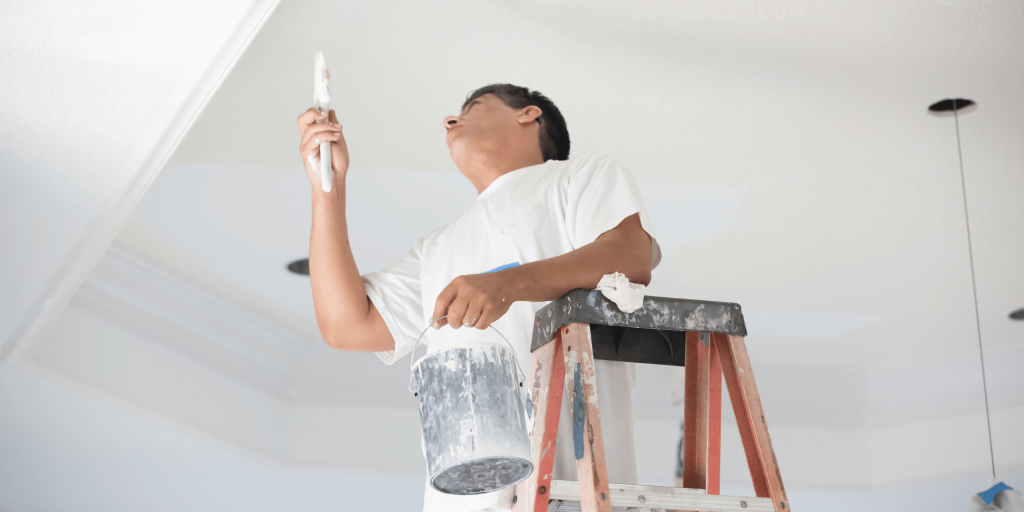
When the ceiling is wet, then it is time to take away the texture.
Tools You’ll Need
- 6 to 12-inch drywall scraper or ceiling scraper
- Ladder or scaffold
Scraping Technique
- Begin at the end of the wet space
- Keep the scraper at 30-degree angle to prevent gouging the drywall
- Finger-massage the texture off in smooth and controlled strokes
- Rewet and work in sections when necessary
Important: Be patient. Rushing or forcing may do harm to the drywall underneath.
Step 5: Repair and Sand the Ceiling
After removing the texture, you will probably see that there will be certain flaws that require prior repairs before painting.
Steps to Repair
Damage: Check to see whether there are holes, dents, or gouges in the drywall
Use Joint Compound: Patch with a putty knife
Allow to Dry: Compound should be allowed to dry after 24 hours
Sand the Ceiling Smooth: Use pole sander or sanding sponge with fine grit sandpaper
Important: To minimize dust, a dust mask and a vacuum sander are good to use
Step 6: Prime and Paint the Ceiling
Priming
- Apply a stain-blocker primer on the surface
- Brush on with roller on a slender extension pole
Painting
- Select a paint that is ceiling specific (mostly flat white)
- Draw long and straight lines moving along in small sections
Important: You may use a paint-and-primer combination to save on time, particularly on new ceilings that have no stains.
- Alternative Options to Removal
If removal seems too time consuming or risky, there are other ways to deal with textured ceilings:
Skim Coating: Coat the texture with a thin coating of joint compound.
Ceiling Panels: This involves decorative panels that are installed on the original ceiling.
Drywall Over: Drywall sheets are directly attached straight to the old ceiling.
These techniques can be timesaving and less messy, yet it takes professional ability or equipment.
Tools & Materials Checklist
The following are some of the things you might be required to have:
| Item | Purpose |
| Spray bottle or garden sprayer | Wetting the ceiling |
| Scraper or drywall knife | Removing texture |
| Ladder or scaffold | Reaching the ceiling |
| Drop cloths/plastic sheeting | Protecting furniture and floors |
| Dust mask and goggles | Personal protection |
| Joint compound & putty knife | Repairing damaged drywall |
| Sandpaper or pole sander | Smoothing the ceiling |
| Primer and paint | Finishing the ceiling |